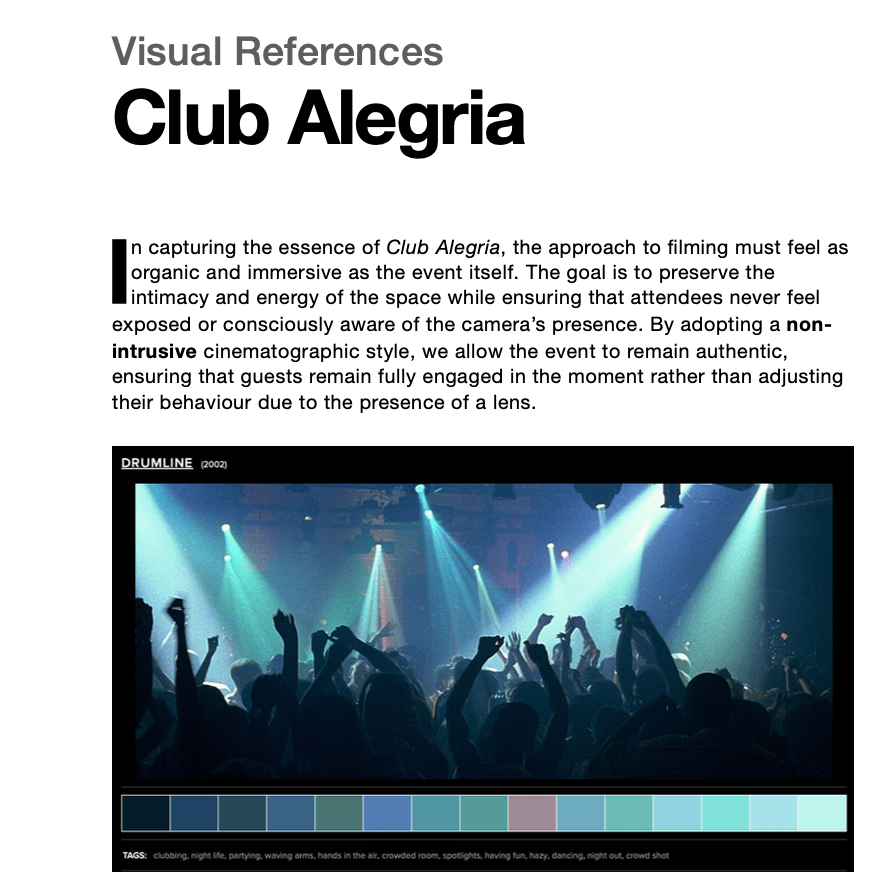
For Club Alegria, I developed a visual and cinematic treatment defining how the event would be documented on film.
Rather than treating the camera as an observer, the approach embeds it within the room — moving with the crowd, responding to the energy, and remaining deliberately unobtrusive. The goal was not to document faces, but to preserve atmosphere: movement, rhythm, proximity, and anonymity.
The filming style is grounded in two core principles:
Extreme wide compositions establish scale while maintaining intimacy. By positioning the camera within the crowd and favouring depth over detail, the space feels expansive without exposing individuals. This reinforces Club Alegria as a place where presence matters more than performance.
Lo-fi, handheld close-ups capture fragments rather than full portraits. Using camcorders and handheld movement introduces grain, blur, and imperfection — leaving space for imagination and memory. The result is footage that feels lived-in, nostalgic, and human, rather than polished or surveillant.
This treatment set the visual rules for how Club Alegria would be filmed:
no staged moments, no direct focus on faces, no interruption of the experience.
The camera exists as another body in the room — responsive, respectful, and invisible.
The outcome is content that doesn’t just show the event, but feels like being inside it.
 About Fran
Leave a comment